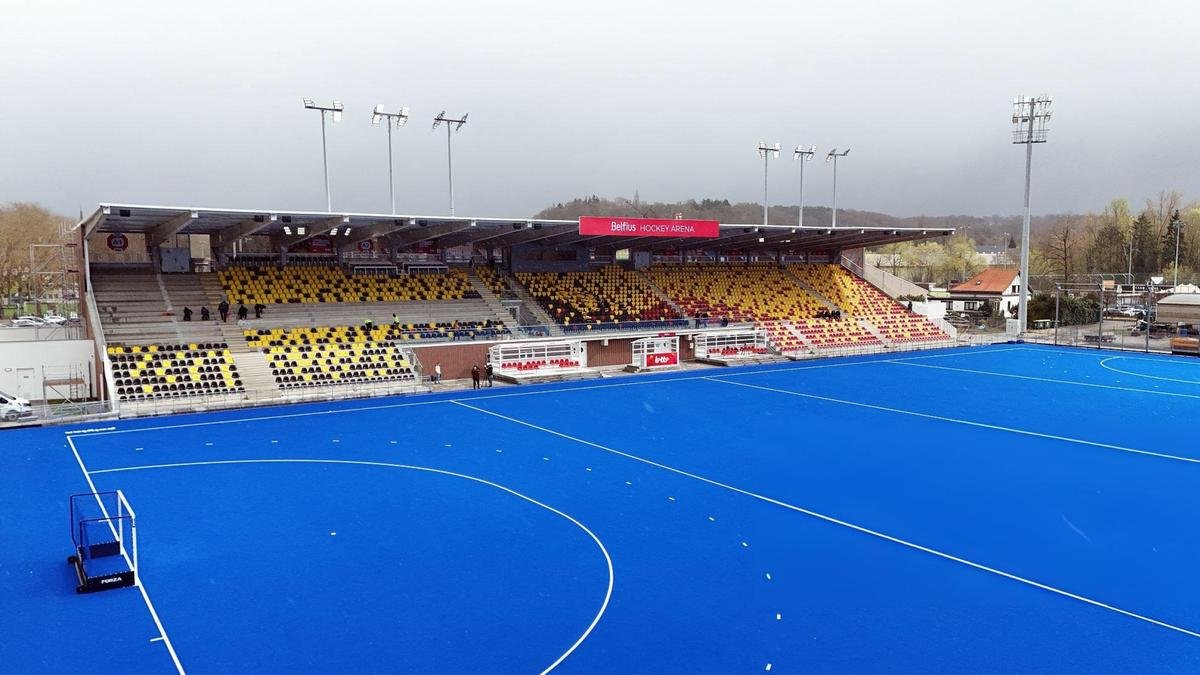
The FIH World Cup 2026 begins August 15 and will be played across two venues: the Belfius Hockey Arena in Wavre, Belgium, and the Wagener Hockey Stadium in Amstelveen, Netherlands.
Both venues had Poligras artificial turf installed shortly before the start of the two-week tournament.
What is Poligras turf?
Poligras, developed by a company called Polytan, is a synthetic carbon-zero hockey turf, made from 80 per cent bio-based material – sugarcane. Its water absorbent properties mean the turf takes in less water as compared to other surfaces, and still provides the zippy surface that a fast-paced hockey game needs.
How does Poligras turf help players?
Due to its synthetic nature, a Poligras surface is subject to less change with usage if maintained properly. The surface consistently delivers the same playing parameters, leading to better player performance. A synthetic surface like Poligras is made to exacting standards under a stringent quality control system, ensuring all functions of that surface contribute to player performance.
Has Poligras turf been used before?
Yes, Polytan provides FIH-approved playing surfaces. Poligras turfs have been used for the 2018, 2022 and 2023 FIH Hockey World Cups, as well as the Olympic Games in Tokyo and Paris. The Poligras Paris GT Zero turf, developed for Paris, was the world’s first carbon-zero hockey turf.
The 2026 edition will mark the 10th time that the Poligras turf has been chosen for a Hockey World Cup.
Published on Aug 11, 2026