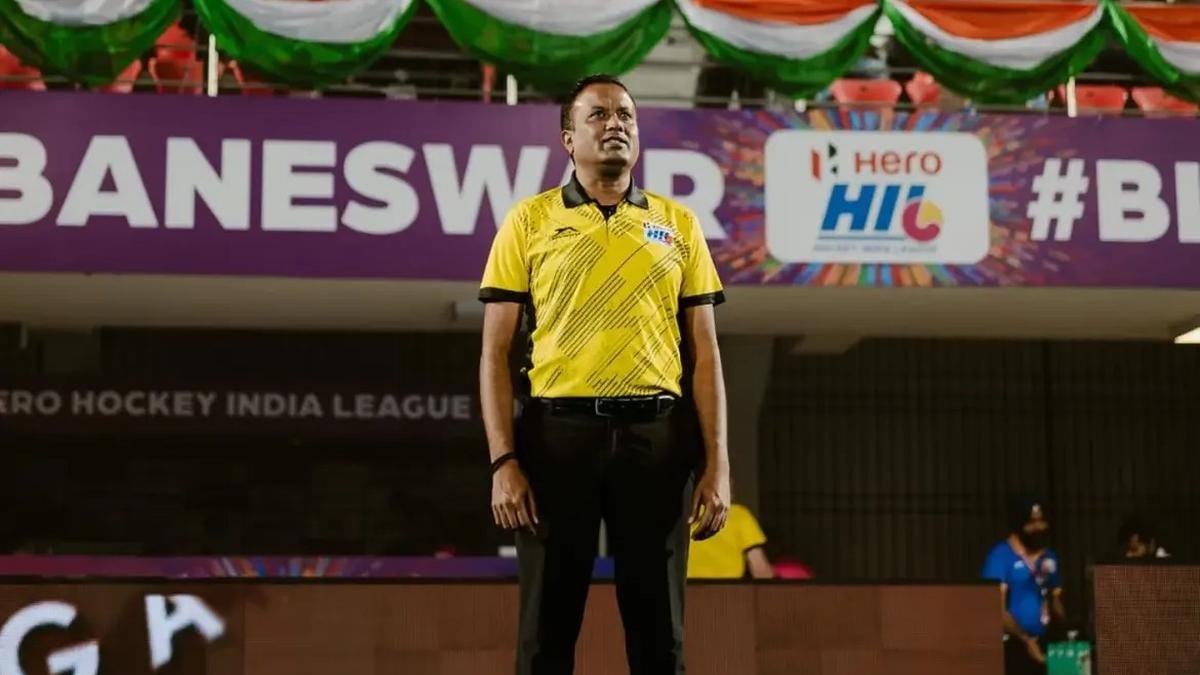
The absence of an Indian umpire or technical official at the upcoming FIH Men’s Hockey World Cup after nearly three decades has left former international officials disappointed, with veterans saying the focus should be on a structured pathway.
For the first time since the 1998 World Cup in Utrecht, the tournament, beginning on August 15 in the Netherlands and Belgium, will not have any Indian umpire or technical official. European countries account for the bulk of the panel.
India has produced only four men’s World Cup umpires in the modern era – Amarjit Singh Bawa (1990), Tarlok Singh Bhullar (1994), Satinder Sharma (2002, 2006, 2010) and R V Raghu Prasad (2010, 2014, 2018 and 2023).
Raghu Prasad, the first Asian umpire to officiate in 200 international matches before retiring last year, said appointments for elite events are based on sustained performances in top-level competitions.
“The FIH Umpiring Committee selects officials for major tournaments after assessing performances in previous World Cups, the Olympics, the Pro League and other international competitions. Consistency over a period of time is the biggest criterion,” he told PTI.
Satinder, who officiated in multiple Olympics and World Cups, described India’s absence from the World Cup officiating panel as disappointing.
“After Bawa Sir and Bhullar Sir, Raghu and I carried forward that legacy. It was never easy to establish ourselves among the European officials. Our men’s team did not qualify for the 2008 Beijing Olympics, but I was still India’s only representative there as an official. That shows how much importance is attached to consistent performances. At present, I feel we are lagging behind,” he said.
According to Hockey India’s list updated in May 2025, the men’s umpiring structure comprises four categories – Core Leading Panel, Leading Panel, High Potential and National Umpires – with more than 100 officials. The women’s structure has over 70 officials.
However, only six Indian men and four women are on the FIH umpiring panel, with Raghu’s retirement reducing the active men’s strength further. Similarly, India has only four men’s and two women’s FIH technical officials despite having a sizeable domestic pool.
ALSO READ | Asian Games 2026: Indian men’s hockey team drawn with Japan, Korea; Pakistan in Pool B
Satinder said Indian umpires needed greater exposure to international hockey to bridge the gap.
“If domestic umpires don’t officiate in major international tournaments, how will they gain experience? There is a huge difference between domestic and international umpiring,” he said.
“Umpires should also be part of national coaching camps so they understand the demands of modern hockey. We have talent, but officials need opportunities and support from the federation. Proper planning and a structured pathway are essential if India wants representation at the next World Cup or Olympics,” he added.
Bawa, who officiated at the 1990 Lahore World Cup and the 1988 Seoul Olympics before retiring in 1994, recalled the lack of recognition for umpires during his career.
“When I started, we received a daily allowance of only Rs 20, which later increased to Rs 100 during KPS Gill’s tenure. In those days, umpires were hardly considered an important part of the sport. There were no medals or souvenirs for umpires either. It was during the 1977 Ranjit Singh Tournament in Amritsar, we ensured that officials were also honoured,” said Bawa, now settled in Canada.
The three veterans agreed that poor financial security remains one of the biggest deterrent for aspiring umpires.
“In our time, we received Rs 150-200 a day in domestic tournaments and an allowance of USD 40-50 during international assignments. Even today, most Indian umpires are either unemployed or officiate only in domestic competitions,” Sharma said.
Raghu, who took up a private job after retiring from international umpiring last year, said the profession offered little financial stability.
“As long as I was umpiring, I devoted myself entirely to it. After retirement, I had to find a private job through my own efforts, and the income is modest. In such circumstances, why would parents encourage their children to become umpires?” he said.
“Players receive awards, government jobs and recognition for outstanding performances. Umpires receive neither salaries nor meaningful incentives. Even those who are employed often struggle to get leave for international assignments,” he noted.
Published on Aug 07, 2026